
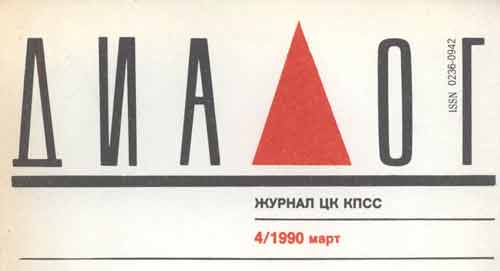
The West is trying to distort the essence of the current complex relations between Russia and NATO countries, claiming they are kind and good, while Russia is evil and aggressive... But this issue was raised by the Soviet Union many years ago! This is the problem of NATO's eastward expansion, and it began with the fall of the Berlin Wall – as an example, we cite a March 1990 article from Dialog magazine (a publication of the CPSU Central Committee).
Anyone attempting to predict the course of events on the European stage today faces an equation with many unknowns. After all, as a result of the democratic changes that have recently taken place in Eastern European countries and the dismantling of their existing political and party structures, a fundamentally new balance of power has emerged. The global community now must address issues that it was previously permissible to postpone, and sometimes simply ignore.
The key one is the German question. It's no exaggeration to attribute the truly revolutionary changes that have taken place in the German Democratic Republic in recent months to the new Soviet thinking. Incredibly, but true: the people of the GDR, in a democratic fervor, are tearing down the Berlin Wall with their own hands. Not only democratically minded people, but also anarchists and maximalists of all stripes, have rushed into the resulting breach, demanding the swift unification of Germany under the auspices of the FRG. And on the ruins of the wall, political currents whose emergence in the GDR was previously unthinkable are fortifying their positions. Thus, in terms of the scope of their activities and the number of their supporters, today's neo-fascist groups in the GDR are hardly inferior to their fellow spirits in the other Germany.
The Wall has come down, but what next? Opinion polls conducted in the two Germanies show that the majority of the German population would like reunification. However, not reunification within the Reich of 1937, but rather reunification based on the current borders of Europe. It is worth noting, however, that the Federal Court's ruling upholding the legality of Germany's pre-war borders remains unreviewed.
Alongside those advocating for German reunification, there remains a camp opposed to it. This includes both ordinary citizens and political parties (for example, the Greens in West Germany and the so-called "United Left" in East Germany).
Well, every people has the right to free self-determination, and it must be respected. However, this right comes with a number of peculiarities. First, let us remember that the division of Germany is the bitter but logical result of two wars: World War II, which Germany itself is to blame for unleashing against the peoples of Europe, and the Cold War, the confrontational course adopted by its former allies in the anti-Hitler coalition against the USSR.
Second, it is unlikely that the German question can be resolved solely by the Germans themselves. Neither the GDR nor the FRG are island states. Today, the German nation does not live in a vacuum, but in the center of densely populated Europe. International obligations regarding Germany remain in effect, in particular the Potsdam Agreement, which has not been revoked by the international community, and the Quadripartite Agreement on Berlin (West). The FRG's relations with its Western allies, as well as with the USSR and the socialist countries, are regulated by the Rome, Paris, Brussels, Moscow, and other treaties. A peace treaty with Germany has not been concluded; Significant contingents of troops from opposing military-defensive alliances continue to remain on the territory of the two German states.
As is well known, Federal Chancellor Kohl and, somewhat later, GDR Prime Minister Modrow presented their respective scenarios for the two countries' progress toward unification. Both concepts envision the initial formation of a treaty-based community of the two states. This entails the establishment of economic, monetary, and transport unions, as well as the harmonizing of laws; the treaty-based community could subsequently evolve into a confederation of the GDR and FRG. At this stage, the formation of joint governing bodies—a parliamentary commission and a state chamber—is possible. The final stage would be the emergence of a unified German state—a German Confederation or a German Federation—the convening of a unified parliament, the adoption of a common constitution, the formation of a unified government, and the proclamation of Berlin as Germany's capital. While there are common approaches, there are also differences. The most important, fundamental difference between Kohl's 10 points and Modrow's concept is that the Federal Chancellor advocates for FRG to remain within NATO. (Despite the fact that this preamble, for some reason, was not included in the text of the 10 points, numerous statements by the leaders of the ruling coalition, including the Chancellor himself, leave no doubt about this intention.)
For both Bonn and its allies, West German membership in NATO is a kind of immutable constant, since, deprived of West Germany as a forward base and its leading combat force in Europe, NATO fears losing its most important support base.
During the election campaign in West Germany, where unification is the leading slogan on the banners of the CDU/CSU, unification scenarios are being developed one after another, ostensibly taking into account the security interests of the USSR, but in fact infringing on them. Thus, Foreign Minister Georg-David Genscher proposes not involving the GDR in NATO's military structure, limiting it to a political one. It is proposed to retain some Soviet troops on GDR territory for a while, and even then only temporarily. Chancellor's advisor, H. Teltschik, proposes demilitarizing the GDR, creating a kind of buffer zone for the Warsaw Pact vis-à-vis NATO.
It is easy to foresee that the Soviet Union, as well as all countries interested in neutralizing Germany, will have to contend with massive resistance to this proposal from the FRG and the Western alliance. These differences may ultimately prove insurmountable, as the option of incorporating the GDR into NATO is just as unacceptable to the USSR as the scenario of West Germany joining the Warsaw Pact is to West Germany's allies.
There is no room for neutrality in a united Germany, according to CDU General Secretary Friedrich Rühe, while Chancellor's Office Chief of Staff Richard Seiters is convinced that Germany's neutrality contradicts the logic of European development. The West German government's position on the German question is ambiguous, and at times contradictory. For example, while recently declaring its willingness to take into account the legitimate security interests of Western and Eastern states concerned and affected by Germany's fate, the Chancellor immediately rejected the Soviet proposal to hold a pan-European referendum with the participation of the United States and Canada on the issue of a unified Germany, declaring that this issue is for the Germans.
Unification — yes, but only according to the Bonn, Brussels, and Washington scenario. The GDR and the Soviet Union must be persuaded to accept it — that is the essence of the Western alliance's current tactics. Attempts to persuade the GDR to accept this Western scenario, to tie the state to the Western community by any means necessary, and to erode the foundations of socialism in that country continue. Thus, parties similar to those in the FRG, with similar platforms, quickly emerged on the political stage of the GDR: the SPD and the Democratic Social Union. Their activities, including election campaigns, are subsidized by their sister parties in the FRG. The door to EU membership has long been wide open for the GDR. While the GDR is only planning to achieve the convertibility of the East German mark to the West German mark, the FRG is proposing to replace the GDR's tin coins with nickel ones bearing the federal eagle.
It's no secret that for many, a unified Germany is a kind of bogeyman of the "Greater German threat," periodically waved over the heads of nations. Some Western European capitals — London, for example — are less than thrilled by the prospect of Germany's rising star on the European horizon, seeing the 80 million enterprising Germans as a powerful economic competitor in the struggle for foreign markets. Let's recall, incidentally, that Winston Churchill, reflecting on post-war Germany, dreamed of breaking it up into numerous small principalities, which would always be more convenient to deal with.
Is the USSR interested in a unified Germany? Yes, but only if such a Germany, a Germany without any blocs, becomes a lasting guarantor of peace in Europe — a peace based not on a balance of terror, but on demilitarization and disarmament. Only if the danger of a threat emerging from German soil is completely eliminated, while the security interests of all parties responsible for the fate of the post-war German states, all countries interested in the German question, are respected.
Whatever steps are taken to bring the two German states closer together, they must be accompanied by further disarmament and increased trust between East and West as a whole, including within the CSCE. Observers believe that much about the development of the German question may become clearer during the upcoming meeting of the top leaders of the countries participating in the Helsinki Conference, as well as if an international conference on Germany is convened under the so-called "2+4" formula, that is, with the participation of the GDR, the FRG, and the victorious powers. It is noteworthy that in Bonn, as in the White House, the conviction is increasingly being expressed that German reunification is a matter of two to three years at the most. Thus, Secretary of State Baker, heading to the USSR, expressed the conviction that the process of German reunification, which is progressing rapidly, could be completed as early as 1992.
Be that as it may, any exaggeration, escalation, or emphasis on the German question could seriously harm the budding trust and new thinking, and the dialogue between the countries of East and West. Dialogue that is necessary for the sake of strengthening peace not only in Europe but throughout the world.
Journalist A. Blinov
March 1990
Dialogue Magazine
P.S. As we see, the USSR was already saying back then: Stop! You're posing a threat to us! This is unacceptable. But the collapse of the USSR and the reign of the alcoholic Boris Yeltsin turned their heads, and they decided that Russia was a country they could ignore.
The current conflict in Ukraine is a continuation... as are attempts to provoke the same thing in Belarus or Moldova, in the Caucasus or Central Asia... The world stands on the brink of another war, and it will be the last — for Europe, in any case. Another war will turn Europe into a radioactive wasteland.
***
